 Dalanovum


Clients & projects / Intygio
A product passport that reveals every change.
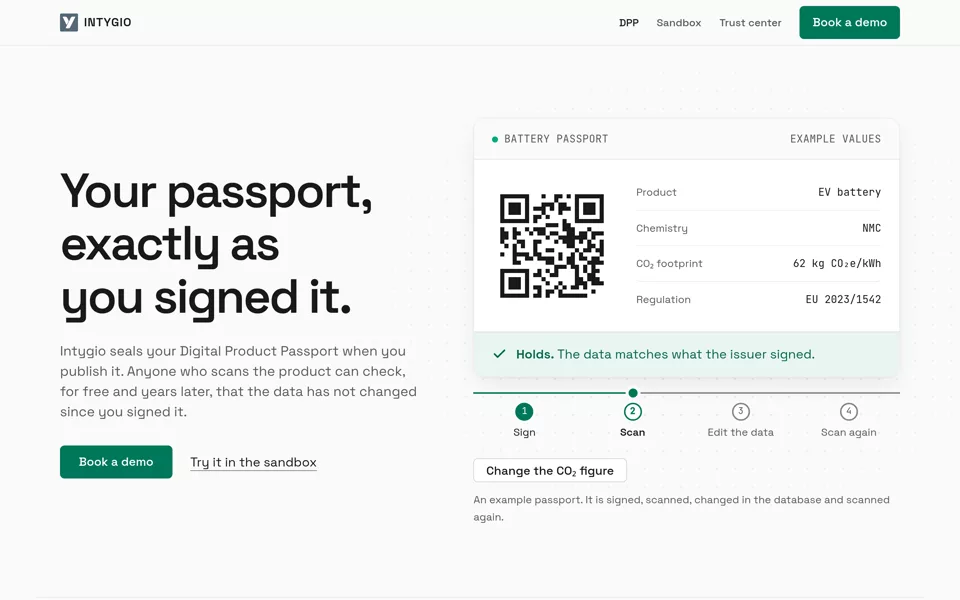
Intygio signs digital product passports, which the EU requires for batteries from 18 February 2027 and then for more product groups. Whoever scans the product can check that the facts are the same as when they were signed, for free and years later.
This deep dive shows one part of the service: how a passport is signed and checked. The interface, the integrations and the website are stories of their own.
- Product groups with their own schema
- 16
- Signature per passport
- P-256
- Steps from fact to check
- 5
- Cost for whoever checks
- Free
The passport in five steps
Pick a step. The difference between making a passport and checking it is the whole point: it is made once, and checked at any time by anyone.
The facts about the product
The manufacturer sends in what the passport must show: model, materials, carbon footprint, recycled content. Intygio has a schema per product group, sixteen today, from batteries to textiles and steel.
Quality assurance in this step
- Do the facts follow the product group's schema?
- Are all the fields the law requires for the group there?
One fixed form
Each field gets a set place and type, and everything is written in exactly one way before anything is signed. Two identical passports are then identical byte for byte, and a change shows at once.
Quality assurance in this step
- Are the same facts always written the same way?
- Does the reader withstand broken and random input?
A seal on the content
The passport is signed with a digital signature (ECDSA P-256). The signature covers exactly that content, so the smallest change breaks it. The key never leaves its protected store.
Quality assurance in this step
- Can the signature be checked right after it is made?
- Does every passport have its own one-time number, so it cannot be copied?
A QR code on the product
The signed passport fits in a QR code. One variant is read by a phone's normal camera, the other is denser and made for industrial readers. The passport is also registered in the EU registry.
Quality assurance in this step
- Does a normal phone camera read the code?
- Does the passport fit in the code at the size the label allows?
Anyone can check
Whoever scans the code sees whether the facts are the same as when they were signed, and who signed them. The issuer is checked against the EU trusted lists. The check is free and also works offline.
Quality assurance in this step
- Does the content match the signature?
- Is the issuer on the EU trusted list?
A change must show
Try it. This page has just made its own key and signed the passport below with the same algorithm as Intygio. Change a fact and the signature is checked again.
Checking …
The page makes a key and signs the passport.
The key exists only in this page and is gone when you close it. In Intygio the key is kept in a protected store, and the issuer is checked against the EU trusted lists.
Built to last for many years
A battery lives for ten years or more. The passport must be checkable all that time, also if the service that made it has moved or does not answer.
- The check works offline, because the signature travels in the code
- Every signing is logged in a chain that cannot be changed afterwards
- Different roles see different fields: consumer, operator, authority and auditor
- Prepared for post-quantum algorithms, whichever becomes the industry standard
Cryptography, EU rules and ten years of durability. The customer sees a QR code.
Whoever scans it gets a simple answer: the details hold, or they have changed. Everything that makes that answer trustworthy stays behind it.
Behind every website we build are as many decisions as the ones you just read about. If you want to talk about what that could mean for you, get in touch.